
San Diego has one of the better safety reputations among major American cities, and the 2024 data largely backs that up. But is San Diego safe to live in? Tthe honest answer is more specific than a simple yes or no.
Crime in San Diego declined for the third consecutive year in 2024, with a violent crime rate of 4.3 per 1,000 residents. It has one of the lowest rates among major US cities. Safety varies significantly by neighborhood, with areas like La Jolla and Coronado ranking among California’s safest, while parts of downtown require real caution.
San Diego is a safe city for residents and visitors alike, but only if you understand the full picture. A single verdict means little without knowing the neighborhood, the hour, and the context. Here’s what the data actually shows.
Key Takeaways:
- San Diego is a safe city overall, with violent crime rates below the national average and three consecutive years of declining crime.
- Safety varies significantly by neighborhood. Areas like La Jolla and Coronado are among California’s safest, while East Village has crime rates 454% above the national average.
- Vehicle break-ins are the most common crime affecting visitors. Never leave valuables visible in a parked car, especially at beach parking lots and the Gaslamp Quarter.
- Property crime, not violent crime, is the daily reality for most San Diego residents. Auto theft and catalytic converter theft are the most frequent concerns.
- Choosing the right neighborhood, securing your car, and knowing which areas to avoid after dark make a real difference.
San Diego Crime Statistics: What the Numbers Actually Say
San Diego’s crime trend is declining over time, but the data doesn’t always mean the city is without risk. According to the SDPD 2024 Annual Crime Report, overall crime fell 1.5% in 2024, marking the third consecutive year of decline. City-wide averages, however, show substantial variation across neighborhoods.
A low figure at the city level can coexist with significantly higher risk in specific areas, and the data below should be read with that in mind.
SAN DIEGO CRIME STATS TABLE — 2024:
| Crime Category | 2024 San Diego | National Average | Trend |
|---|---|---|---|
| Violent Crime Rate (per 1,000 residents) | 4.3 | ~4.0 | ↓ Down 1.1% |
| Murder Rate (per 100,000 residents) | 2.5 | ~5.5 | ↓ Down 22.2% |
| Sexual Assault | Below national avg. | National avg. | ↓ Down 10.9% |
| Non-Fatal Shootings | 145 cases | — | ↓ Down 32% |
| Property Crime Rate (per 100,000) | 1,883 | ~2,200 | ↓ Down 4.7% |
| Motor Vehicle Theft | 1 in 246 chance | — | ↓ Down 19.5% |
| Overall Crime Change (2024) | −1.5% | — | 3rd consecutive year of decline |
| Gang-Related Crime | Down 11% | — | Gang members down 31% |
Source: San Diego Police Department — 2024 Annual Crime Report. Data collected per FBI National Incident Based Reporting System (NIBRS) guidelines.
What these figures don’t show is equally important. Many crimes, particularly petty theft, vehicle break-ins, and sexual assault, are chronically underreported, meaning actual incident rates are higher than official counts suggest.
Tourist-facing crimes like pickpocketing and bag theft concentrate in specific high-footfall areas and look nothing like the day-to-day property crime profile of residential neighborhoods.
And because the city-wide average blends communities as different as Scripps Ranch and East Village, it tells you very little about what crime actually looks like on any specific street.
San Diego Neighbourhood Safety Breakdown
The city-wide crime average can be a misleading number in any San Diego safety concerns. Two people can live within five miles of each other and experience entirely different levels of risk.
La Jolla and Coronado rank among the safest communities in the entire state of California. East Village, by contrast, has crime rates 454% above the national average. In San Diego, where you are matters far more than what city you’re in.
NEIGHBOURHOOD SAFETY TABLE:
| Neighbourhood | Safety Level | Key Characteristics | Main Concerns |
|---|---|---|---|
| La Jolla | Very Safe | Affluent coastal area. Among the lowest crime rates in San Diego. Family-friendly with strong community presence. | Occasional vehicle break-ins near beach parking lots. Otherwise very low risk. |
| Coronado | Very Safe | Island community. One of San Diego’s lowest crime rates citywide. | Minimal concerns. Primarily residential with limited commercial crime exposure. |
| Scripps Ranch | Very Safe | Suburban, family-oriented. 75% lower crime than the San Diego average. Top-rated schools. | Low risk. Wildfire awareness is advisable given proximity to open space. |
| Rancho Bernardo | Very Safe | Master-planned community. 67% below the national crime average. Active HOA presence. | Very low risk. Commuter traffic is the primary concern. |
| Carmel Valley | Very Safe | Affluent suburban enclave. Consistently low crime. Strong neighbourhood watch activity. | Very low risk. Property crime is among the lowest in the county. |
| Mira Mesa | Safe | Mixed residential and commercial. Below-average crime. Diverse, established community. | Occasional vehicle break-ins. Minor property crime in commercial zones. |
| Hillcrest | Moderately Safe | LGBTQ+ neighbourhood. Generally safe but higher foot traffic creates petty crime exposure. | Pickpocketing and vehicle break-ins are the primary concerns. |
| North Park | Moderately Safe | Trendy arts and dining district. Popular with young professionals. Improving crime trend. | Car break-ins near entertainment strips. Some late-night disturbances. |
| Gaslamp Quarter | Caution at Night | Major tourist and nightlife hub. Safe during the day. Elevated risk after 10 PM. | Pickpocketing, theft, and altercations increase significantly after dark. |
| East Village | High Risk | Crime rates 454% above the national average. Highest incident concentration downtown. | Property crime, assault, and drug-related activity are significant concerns. |
| Lincoln Park | High Risk | Above-average violent crime. Gang activity present. Not recommended for tourists. | Gang-related incidents, assault, and robbery above the city average. |
| City Heights | Use Caution | Diverse, densely populated. Improving with community policing but above-average crime. | Auto theft and property crime are common. Active improvement underway. |
Before making any decisions about where to live, work, or stay, check the SDPD Crime Mapping tool at crimemapping.com for property-specific incident data updated in real time.
Is San Diego Safe to Visit?
San Diego is a welcoming city for tourists and short-term visitors, but smart travel means knowing the specifics, not just the headline. Here’s what first-time visitors actually need to know.
- Neighbourhood Safety
The Embarcadero, Little Italy, Balboa Park, La Jolla Cove, Old Town, and Coronado are all low-risk areas. The Gaslamp Quarter is safe by day but unpredictable after 10 PM.
Travel in groups and keep valuables out of sight. Avoid East Village and 16th Street after dark. At Mission Beach and Pacific Beach, never leave valuables in your car or on the sand.
- Travel Safety, Including Food and Drinks
San Diego’s food system is well-regulated, tap water is safe city-wide, and street vendors are licensed by San Diego County Environmental Health.
In Gaslamp Quarter bars, keep drinks covered and never leave them unattended. Crossing into Tijuana requires standard border precautions; this is entirely separate from San Diego’s own safety profile.
- Natural Disasters
San Diego sits in a seismically active region and faces seasonal wildfire risk in inland areas during Santa Ana wind conditions between October and January.
Coastal areas carry minimal exposure. Flooding is rare but possible in low-lying areas. Visitors staying more than a few days should bookmark readysandiego.org for real-time emergency alerts.
Is It Safe to Walk Around San Diego at Night?
Most of San Diego is perfectly walkable after dark with basic urban awareness. The Embarcadero, Little Italy, Coronado, La Jolla, and Mission Hills are all safe at night with minimal concern. The Gaslamp Quarter is active and generally fine before 10 PM.
Pickpocketing and alcohol-fueled altercations increase after 10 PM near the bar strips, so travel in groups and keep your phone pocketed. East Village and the 16th Street corridor should be avoided after dark, regardless of your starting point.
Which Tourist Spots Should You Be Careful In?
San Diego’s main attractions are largely safe, but each has its own specific consideration.
- Balboa Park is fine during daylight hours; keep your bag in front of you in crowded museum areas.
- The San Diego Zoo is a controlled environment with very low risk.
- La Jolla Cove and Old Town are both safe with no notable concerns.The Gaslamp Quarter is relaxed during the day.
- Mission Beach and Pacific Beach require one firm rule: never leave valuables in your car or unattended on the sand.
- Vehicle break-ins at beach parking lots are the single most common tourist-facing crime in San Diego.
What Crimes Are Most Likely to Affect Visitors?
The three crimes most likely to affect a San Diego visitor are vehicle break-ins, pickpocketing in high-footfall areas, and petty theft at beaches. Among these, vehicle break-ins are by far the most common; a bag left visible on a back seat is enough of a trigger. Pickpocketing incidents increase in the Gaslamp Quarter, Balboa Park, and Comic-Con weekends.
Violent crime against tourists in the main visitor zones is rare and not a major day-to-day concern. San Diego’s closeness to Tijuana also contributes to regional drug trafficking activity, but this is controlled by law enforcement; it has no meaningful impact on standard tourist activity.
Is San Diego Safe to Live In?
Living in San Diego looks different from visiting it. The tourist experience is concentrated in a handful of well-managed areas. Daily life as a resident means engaging with a much wider range of neighbourhoods, commutes, and routines.
Here is what safety actually looks like from the ground up. Here are the common concerns people have before they plan to settle in San Diego.
Is San Diego Safe for Families?
Yes, but neighborhood selection is the decision that matters most. Scripps Ranch, Rancho Bernardo, Carmel Valley, and Poway consistently rank among the safest family environments in Southern California, combining low crime rates with strong school systems and active community engagement.
Families moving to San Diego should prioritize the northern and suburban districts over downtown-adjacent neighborhoods. With a violent crime rate of 4.3 per 1,000 residents and the right postcode, San Diego is genuinely well-suited to family life.
Is San Diego Safe for Women Living Alone?
Generally, yes, particularly in the coastal and northern neighborhoods. According to the San Diego Police Department, sexual assault decreased 10.9% in 2024 and has been on a consistent downward trend since 2022. San Diego compares favorably to both Los Angeles and San Francisco on this metric.
The practical precautions are the same as in any major city: standard awareness in entertainment districts after dark, avoiding poorly lit streets in East Village and City Heights at night, and keeping cars locked. None of these are San Diego-specific risks; they are simply urban realities applied to a safer-than-average city.
What Are the Biggest Safety Concerns for Residents Day-to-Day?
For most San Diego residents, violent crime is not a daily reality. Property crime is. Vehicle break-ins and auto theft are the most common issues residents actually encounter. Despite a significant 19.5% drop in motor vehicle theft in 2024, the chance of vehicle theft still sits at 1 in 246. Catalytic converter theft has been a recurring issue in suburban and mid-tier commercial areas.
To avoid experiencing thefts, follow these precautionary measures:
- Never leave anything visible in a parked car.,
- Use secured or covered parking where available.
- Understand the risk profile of your specific neighborhood rather than relying on city-wide averages.
What Is Being Done to Improve Safety in San Diego?
San Diego’s declining crime rate is not a passive trend; it is the result of specific, measurable initiatives across law enforcement, technology, and community engagement. Understanding what is driving the improvement gives both residents and businesses a clearer picture of where the city is heading.
How Has Crime Changed Over the Last 3 Years?
- Overall crime fell 2.7% in 2023, followed by a further 1.5% decline in 2024, three consecutive years of reduction.
- Homicides dropped 22–25% between 2023 and 2025.
- 70%+ of all tracked crime categories decreased in 2024 alone.
- This is a sustained, compounding trend, not a single-year correction.
- While many major US cities saw crime rise or plateau over the same period, San Diego continued to improve.
What Is the SDPD Doing Differently?
- Smart streetlight cameras and automated license plate readers are directly credited with the 19.5% drop in motor vehicle theft in 2024.
- Targeted gang intervention programs: documented gang members reduced by 31%, gang-related crime cut by 11%.
- Community partnership policing and neighborhood watch programs credited with holding residential burglary rates steady through 2024.
- SDPD Chief Scott Wahl lauded the 1.5% decrease in the crime rate as the result of outstanding police work, strong community partnerships, and strategic use of technology.
How Does Private Security Fill the Gaps?
Municipal policing is inherently reactive; officers respond after an incident has been reported. Private security operates differently, providing a proactive deterrent layer through visible guard presence, access control, mobile patrol coverage, and on-site incident response before law enforcement arrives.
The reason behind a noticeable decline in San Diego’s crime rate trends is people’s trust in hiring private security companies. For San Diego businesses, events, and residential communities, private security has become an increasingly practical complement to SDPD resources, particularly in commercial zones, construction sites, and high-footfall venues where visible, trained armed or unarmed security guards maintain safety through ongoing surveillance, access control, and proactive threat detection.
8 Safety Tips Every San Diego Visitor Should Know
San Diego is a safe city to visit, but a few simple things can help you enjoy your trip while avoiding any unpleasant incidents. The following eight San Diego safety tips are specific to how crime actually occurs in the city, and how you can avoid any mishaps.
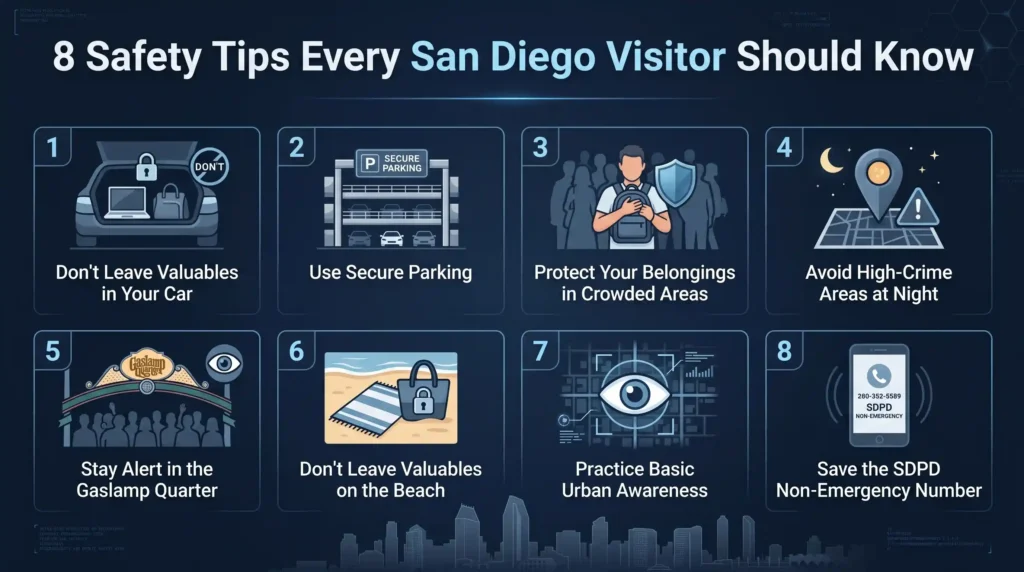
1. Never leave anything visible in a parked car
Vehicle break-ins are the most common crime affecting tourists in San Diego. A bag on the back seat, even an empty one, is enough to trigger a smashed window.
2. Use hotel or secured parking
Surface lots in the Gaslamp Quarter and around Balboa Park carry the highest break-in risk. Covered, attended parking is worth the extra cost.
3. Keep bags zipped and worn in front in crowded areas
Comic-Con, Gaslamp Quarter weekends, and the Zoo are active pickpocket environments. A zipped bag worn across the chest removes the opportunity entirely.
4. Avoid East Village and 16th Street after dark
These areas carry crime rates well above the city average. There is no tourist reason to be there at night.
5. Travel in groups in the Gaslamp Quarter after 10 PM:
Stick to well-lit main streets and keep your phone pocketed. Theft and altercations increase significantly near the bar strips after midnight.
6. Never leave valuables on the beach:
Use a car boot lockbox or take valuables with you. Unattended towels are an easy target at Mission Beach and Pacific Beach.
7. San Diego is safe for solo travel, including solo female travel:
Standard urban awareness applies, well-lit routes, trusted transport, and drinks covered in bars.
8. Save the SDPD non-emergency number: (619-531-2000):
Most situations that feel unsafe do not require 911. Having this number ready means you can report incidents quickly without escalating unnecessarily.
How to Protect Your Home in San Diego?
Knowing the city-wide crime trend is one thing; knowing what that means for your specific property is another. San Diego’s most common residential risks are predictable and preventable. Here is where to focus first.
The Biggest Home Security Risks in San Diego
- Vehicle Break-ins: The most frequently experienced property crime for San Diego homeowners. Coastal and affluent areas are particularly exposed near beach access points, where parked cars are targeted opportunistically, even without visible valuables inside.
- Auto Theft: Although there has been a 19.5% decline in auto theft in 2024, it still remains a genuine risk. Suburban neighborhoods and areas with high street parking availability are the most common targets.
- Catalytic Converter Theft: A persistent issue in suburban corridors, including Mira Mesa and mid-tier commercial areas. Hybrid and older-model vehicles are disproportionately targeted due to higher converter metal value.
- Residential Burglary: Residential break-ins are lower than the national average, but not absent. Homes in transitional neighborhoods bordering higher-crime areas carry measurably greater exposure than those in established suburban communities.
- Opportunistic Entry: Unsecured sliding doors and ground-floor windows are the most common access points in San Diego’s older coastal and mid-century homes, a risk that smart sensors and secondary locks directly address.
Practical Steps San Diego Homeowners Can Take Right Now
- Install motion-activated exterior lighting: It is the highest-ROI deterrent available. Opportunistic criminals avoid well-lit properties.
- Use a steering wheel lock or GPS tracker: Vehicle theft remains above a comfortable threshold despite recent declines. Both of these act as visible deterrents and recovery aids.
- Join or start a neighborhood watch group: SDPD directly credits these programs with holding residential burglary rates steady through 2024.
- Secure sliding doors and windows: A disproportionately common entry point in San Diego’s older coastal and mid-century homes, a secondary lock bar costs under $20.
- Consider a residential security patrol: If you live in a higher-risk area or manage a gated community, a residential security patrol can be a wise move. A scheduled patrol presence changes the risk calculation for would-be offenders.
How to Protect Your Business in San Diego
San Diego’s improving crime trend is good news for business owners, but declining citywide numbers do not eliminate commercial risk. Certain business types and locations carry consistent, documented vulnerabilities that are manageable with the right preparation in place.
The Security Risks San Diego Businesses Face
High-end businesses, high-foot-traffic areas, and sites with heavy inventory can face different security threats.
- Retail Theft and Shoplifting: Commercial districts, including Mission Valley, downtown, and University Town Center, see the highest concentration of retail theft incidents. Organized shoplifting has become an increasing concern for mid-size retailers without dedicated loss prevention.
- Construction Site Theft: Equipment and material theft costs San Diego contractors millions annually. Active construction zones, particularly in rapidly developing areas, are targeted regularly for tools, copper wiring, and machinery left unsecured overnight.
- Vandalism and Unauthorized Access: Office buildings and warehouses in mid-tier commercial zones frequently report vandalism and perimeter breaches as their most common security incidents. These are low-drama crimes that compound into significant repair and operational costs over time.
- Event and Crowd Management Risk: Large gatherings, from corporate events to public festivals, carry access control and crowd management risks that require planning. Incidents at events are rarely random; they are almost always the result of insufficient preparation.
What Types of Security Work Best for San Diego Businesses?
The right security approach depends entirely on your business type and risk profile. Here is a straightforward framework that can help you decide what security measures you should take:
- Retail Stores: Uniformed guard presence is the most effective deterrent for shoplifting and provides visible reassurance for both staff and customers during trading hours.
- Construction Sites: 24/7 on-site guard or scheduled mobile patrol directly addresses overnight equipment and material theft, which is when the majority of site losses occur.
- Office Buildings: Lobby security and access control manage unauthorized entry at the point of vulnerability, the front door, before an incident reaches the interior.
- Events and Large Gatherings: Crowd management, credential-based access control, and coordinated emergency response need to be planned before the event, not improvised during it.
- Warehouses and Logistics: Perimeter patrol and after-hours monitoring cover the window of highest exposure: overnight and weekend hours when staff are absent and response times are longest.
How Professional Security Guard Inc. Serves San Diego Businesses
Professional Security Guard Inc. is a licensed, BSIS-certified security company serving San Diego County across commercial guard services, event security, mobile patrol, fire watch, and emergency response.
Our professional and trained security professionals work with offices, retail stores, warehouses, construction sites, and events throughout the county, including La Jolla, Downtown, Chula Vista, and Coronado.
If your business operates in San Diego and needs a structured security assessment, contact Professional Security Guard Inc. for a free consultation and tailored security plan.
Frequently Asked Questions About Safety in San Diego
Is San Diego safer than Los Angeles?
Yes, by most measures. San Diego’s violent crime rate of 4.3 per 1,000 residents is significantly lower than that of Los Angeles, and the city has ranked among the safest large US cities for three consecutive years. Property crime rates are also lower, with the gap most pronounced in violent categories, including homicide and assault.
What is the most dangerous neighbourhood in San Diego?
East Village has the highest crime concentration in the city, with rates 454% above the national average. Lincoln Park also records above-average violent crime with documented gang activity. Both are specific, contained areas; the rest of downtown and San Diego’s northern districts are considerably safer by comparison.
Is downtown San Diego safe at night?
It depends on the specific area. The Embarcadero and Little Italy are generally safe at night with standard awareness. The Gaslamp Quarter is manageable before midnight, but becomes less predictable near bar strips after that. The East Village should be avoided after dark. Stay on well-lit, populated streets and travel in groups where possible.
Is San Diego safe for solo female travelers?
Yes. San Diego is one of the more accessible US cities for solo female travelers. Sexual assault rates declined 10.9% in 2024 and sit below the national average. Standard precautions apply: avoid poorly lit areas after dark, keep drinks covered in bars, and stay within the main tourist and coastal zones.
Does San Diego have a high crime rate compared to the rest of California?
No. San Diego’s crime rates fall below the California state average for both violent and property crime. It consistently outperforms Los Angeles, San Francisco, and Oakland across virtually every crime metric. Among California’s large cities, San Diego ranks as one of the safest.
San Diego Is Safe, But Awareness Always Matters
Three consecutive years of declining crime data confirm what many residents already know: San Diego is genuinely one of America’s safer large cities. But safety here is not a blanket condition. Neighbourhood choice, time of day, and basic situational awareness make a material difference to how that safety is actually experienced. For businesses and residents who want an additional layer of protection, professional security remains the practical complement to what San Diego’s police and community programmes are already delivering. Get in touch with Professional Security Guard Inc. to discuss your security needs today.